

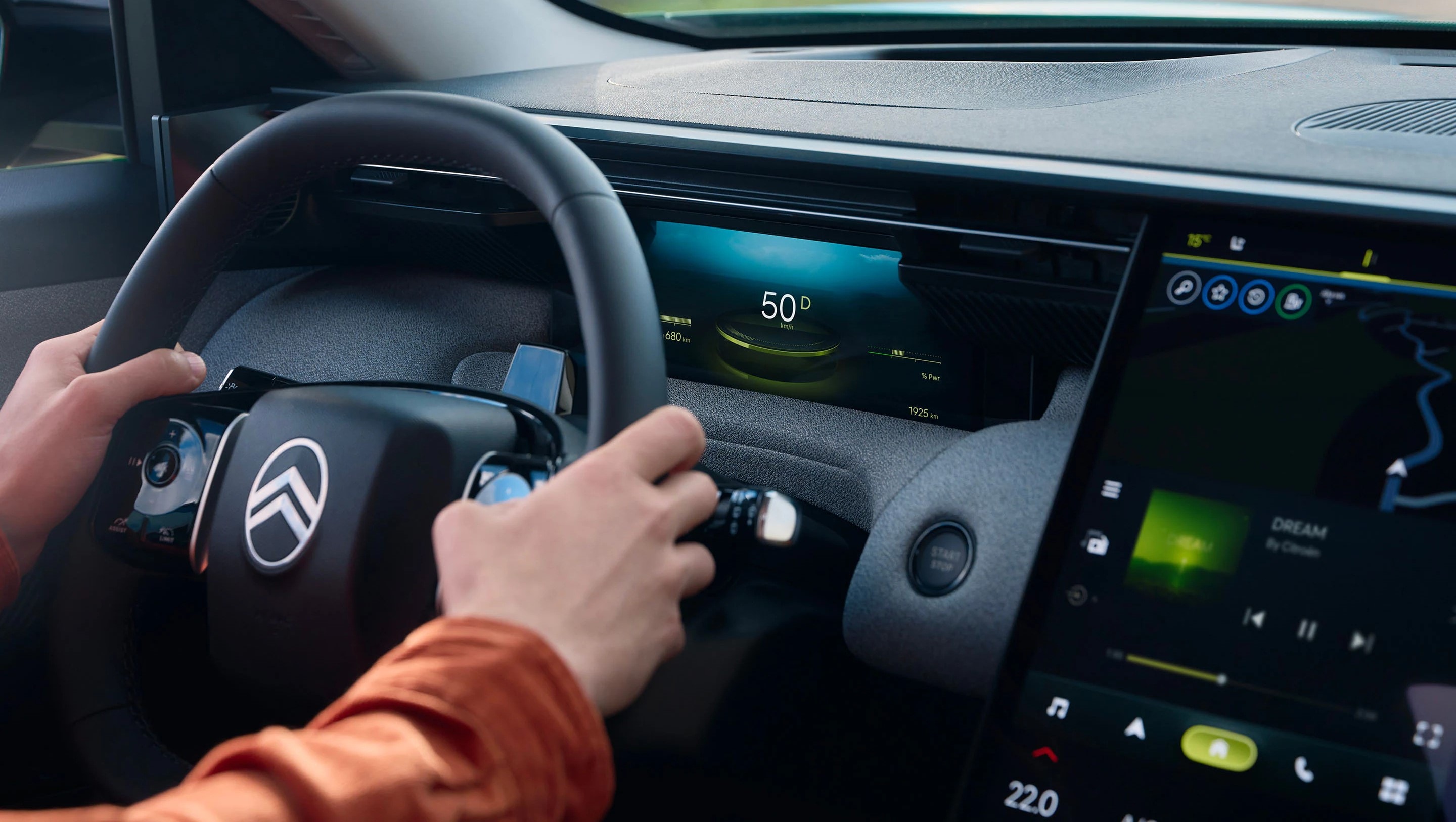

Electric is easy with Citroën
The Citroën electrified range: 100% electric, plug-in hybrid and hybrid
WHY CHOOSE AN ELECTRIFIED VEHICLE?
100% electric
Zero Tailpipe emissions
Plug-in hybrid
Hybrid
Fuel efficiency
Our 100% electric vehicles
100% Electric engine technologies
Our Plug-in hybrid vehicles
Plug-in hybrid engine technologies
Our hybrid vehicles
Mild hybrid (MHEV) engine technologies
WHY CHOOSE A FULLY ELECTRIC VEHICLE?

Zero emissions

Cost-effective
Save on maintenance and reduce fuel expenses thanks to home charging and affordable public stations.

Driving pleasure

Peace of mind
DAILY LIFE WITH AN ELECTRIFIED VEHICLE

(100% electric and plug-in hybrid)
Simply plug in at home overnight or use one of thousands of public charging points when you need to charge on the go.
(100% electric and plug-in hybrid)
Simply plug in at home overnight or use one of thousands of public charging points when you need to charge on the go.

(100% electric)
Plan longer journeys with ease using e-ROUTES in the MyCitroën app. It helps you locate charging stations along your route and optimise your journey.
(100% electric)
Plan longer journeys with ease using e-ROUTES in the MyCitroën app. It helps you locate charging stations along your route and optimise your journey.

(100% electric and plug-in hybrid)
Discover our wide range of chargers and advanced, cost-effective charging and energy services with Free2move Charge Business.
(100% electric and plug-in hybrid)
Discover our wide range of chargers and advanced, cost-effective charging and energy services with Free2move Charge Business.

Go everywhere
SWITCHING TO ELECTRIC IS EASY!

Optimise your charging time
Make the most of your range
Save on everyday costs
FAQ
Lorem ipsum ?
Lorem ipsum dolor sit amet, consectetur adipiscing elit, sed do eiusmod tempor incididunt ut labore et dolore magna aliqua. Ut enim ad minim veniam, quis nostrud exercitation ullamco laboris nisi ut aliquip ex ea commodo consequat. Duis aute irure dolor in reprehenderit in voluptate velit esse cillum dolore eu fugiat nulla pariatur. Excepteur sint occaecat cupidatat non proident, sunt in culpa qui officia deserunt mollit anim id est laborum.
Lorem ipsum ?
Lorem ipsum dolor sit amet, consectetur adipiscing elit, sed do eiusmod tempor incididunt ut labore et dolore magna aliqua. Ut enim ad minim veniam, quis nostrud exercitation ullamco laboris nisi ut aliquip ex ea commodo consequat. Duis aute irure dolor in reprehenderit in voluptate velit esse cillum dolore eu fugiat nulla pariatur. Excepteur sint occaecat cupidatat non proident, sunt in culpa qui officia deserunt mollit anim id est laborum.
Lorem ipsum ?
Lorem ipsum dolor sit amet, consectetur adipiscing elit, sed do eiusmod tempor incididunt ut labore et dolore magna aliqua. Ut enim ad minim veniam, quis nostrud exercitation ullamco laboris nisi ut aliquip ex ea commodo consequat. Duis aute irure dolor in reprehenderit in voluptate velit esse cillum dolore eu fugiat nulla pariatur. Excepteur sint occaecat cupidatat non proident, sunt in culpa qui officia deserunt mollit anim id est laborum.
Lorem ipsum ?
Lorem ipsum dolor sit amet, consectetur adipiscing elit, sed do eiusmod tempor incididunt ut labore et dolore magna aliqua. Ut enim ad minim veniam, quis nostrud exercitation ullamco laboris nisi ut aliquip ex ea commodo consequat. Duis aute irure dolor in reprehenderit in voluptate velit esse cillum dolore eu fugiat nulla pariatur. Excepteur sint occaecat cupidatat non proident, sunt in culpa qui officia deserunt mollit anim id est laborum.
Lorem ipsum ?
Lorem ipsum dolor sit amet, consectetur adipiscing elit, sed do eiusmod tempor incididunt ut labore et dolore magna aliqua. Ut enim ad minim veniam, quis nostrud exercitation ullamco laboris nisi ut aliquip ex ea commodo consequat. Duis aute irure dolor in reprehenderit in voluptate velit esse cillum dolore eu fugiat nulla pariatur. Excepteur sint occaecat cupidatat non proident, sunt in culpa qui officia deserunt mollit anim id est laborum.
Lorem ipsum ?
Lorem ipsum dolor sit amet, consectetur adipiscing elit, sed do eiusmod tempor incididunt ut labore et dolore magna aliqua. Ut enim ad minim veniam, quis nostrud exercitation ullamco laboris nisi ut aliquip ex ea commodo consequat. Duis aute irure dolor in reprehenderit in voluptate velit esse cillum dolore eu fugiat nulla pariatur. Excepteur sint occaecat cupidatat non proident, sunt in culpa qui officia deserunt mollit anim id est laborum.
Lorem ipsum ?
Lorem ipsum dolor sit amet, consectetur adipiscing elit, sed do eiusmod tempor incididunt ut labore et dolore magna aliqua. Ut enim ad minim veniam, quis nostrud exercitation ullamco laboris nisi ut aliquip ex ea commodo consequat. Duis aute irure dolor in reprehenderit in voluptate velit esse cillum dolore eu fugiat nulla pariatur. Excepteur sint occaecat cupidatat non proident, sunt in culpa qui officia deserunt mollit anim id est laborum.
Lorem ipsum ?
Lorem ipsum dolor sit amet, consectetur adipiscing elit, sed do eiusmod tempor incididunt ut labore et dolore magna aliqua. Ut enim ad minim veniam, quis nostrud exercitation ullamco laboris nisi ut aliquip ex ea commodo consequat. Duis aute irure dolor in reprehenderit in voluptate velit esse cillum dolore eu fugiat nulla pariatur. Excepteur sint occaecat cupidatat non proident, sunt in culpa qui officia deserunt mollit anim id est laborum.
Lorem ipsum ?
Lorem ipsum dolor sit amet, consectetur adipiscing elit, sed do eiusmod tempor incididunt ut labore et dolore magna aliqua. Ut enim ad minim veniam, quis nostrud exercitation ullamco laboris nisi ut aliquip ex ea commodo consequat. Duis aute irure dolor in reprehenderit in voluptate velit esse cillum dolore eu fugiat nulla pariatur. Excepteur sint occaecat cupidatat non proident, sunt in culpa qui officia deserunt mollit anim id est laborum.
Lorem ipsum ?
Lorem ipsum dolor sit amet, consectetur adipiscing elit, sed do eiusmod tempor incididunt ut labore et dolore magna aliqua. Ut enim ad minim veniam, quis nostrud exercitation ullamco laboris nisi ut aliquip ex ea commodo consequat. Duis aute irure dolor in reprehenderit in voluptate velit esse cillum dolore eu fugiat nulla pariatur. Excepteur sint occaecat cupidatat non proident, sunt in culpa qui officia deserunt mollit anim id est laborum.
Lorem ipsum ?
Lorem ipsum dolor sit amet, consectetur adipiscing elit, sed do eiusmod tempor incididunt ut labore et dolore magna aliqua. Ut enim ad minim veniam, quis nostrud exercitation ullamco laboris nisi ut aliquip ex ea commodo consequat. Duis aute irure dolor in reprehenderit in voluptate velit esse cillum dolore eu fugiat nulla pariatur. Excepteur sint occaecat cupidatat non proident, sunt in culpa qui officia deserunt mollit anim id est laborum.
Lorem ipsum ?
Lorem ipsum dolor sit amet, consectetur adipiscing elit, sed do eiusmod tempor incididunt ut labore et dolore magna aliqua. Ut enim ad minim veniam, quis nostrud exercitation ullamco laboris nisi ut aliquip ex ea commodo consequat. Duis aute irure dolor in reprehenderit in voluptate velit esse cillum dolore eu fugiat nulla pariatur. Excepteur sint occaecat cupidatat non proident, sunt in culpa qui officia deserunt mollit anim id est laborum.
GLOSSARY
AC (Alternating Current)
Alternating Current (AC), generated by power plants and distributed through the public grid, is the most common form of electricity.
In electric vehicles, although batteries store energy as Direct Current (DC), AC is used for charging via domestic outlets or standard charging stations. The onboard charger converts AC to DC to power the battery. The charging speed is measured in kilowatts (kW).
AC charging
This is the most common charging method for electric vehicles, using alternating current (AC). AC charging is slower than DC fast charging but is more widespread and can be found in many locations, including at home or at work.
Battery
The battery of an electric vehicle is the component that stores and redistributes the energy required to power the motor(s). It is made up of electrochemical cells that store energy in the form of electricity. Its capacity is measured in kilowatt-hours (kWh).
BEV
A BEV (Battery Electric Vehicle) is a type of electric vehicle that is powered entirely by electricity stored in its battery. It has no internal combustion engine (ICE) and operates solely using an electric motor. The battery is charged by plugging the vehicle into an electric power source.
Brake (B Mode)
Citroën vehicles feature a "B" or "Brake" mode to activate regenerative braking. You have the option to coast with minimal regeneration in "D" (Drive) mode, or you can activate the "B" mode for a fixed level of regeneration. This mode is particularly useful in cities, where frequent stops help maximize energy recovery.
Cable
A charging cable is an electric cable that is used to connect an electric vehicle to a charging station or outlet. The cable is equipped with connectors at each end, which must be compatible with both the vehicle’s port and the charging station’s port.
New Citroën vehicles come with a cable. Depending on the vehicle, it may be a cable compatible with a domestic outlet (domestic cable) or one that allows connection to a wall box or public charging station (Type 2 cable).
On fast and ultra-fast charging stations, the cable is attached and integrated into the equipment. This allows the vehicle to be connected with a single action and to take advantage of very high charging power.
CCS
The CCS plug is a combined plug for AC and DC. Alternating current (AC) flows through the upper, round part whereas direct current (DC) is transmitted through the two contacts in the lower part and is also used for high-power charging. It is largely used in Europe.
Cell
A battery is made up of several cells, which can be small cylinders similar to regular batteries or plates like those in a smartphone battery. These cells store electricity through chemical elements. They are often grouped into modules, which are then assembled into packs to form the battery, like Russian dolls.
Charging curve
Charging an electric car is not done at a constant rate, unlike filling up a fuel tank. It's more like filling a water bottle: initially, the flow is high, but it gradually decreases to prevent overflow. This is also the case with fast charging for electric vehicles, where the flow reduces significantly once the battery reaches 80% charge.
Depending on the type of charging station and the battery’s charge level, the vehicle's software adjusts the power to limit overheating and extend battery life. Each manufacturer defines its own charging curve, aiming to strike a balance between charging speed and battery durability.
Charging from 0 to 80%
Between 0% and 80% of its capacity, an electric car battery can generally charge at high power. Beyond that, the charging rate is significantly reduced due to physical limitations. This can be compared to filling a water bottle: the tap is fully open when the bottle is empty but is gradually closed as it nears the neck to prevent overflow. This is why manufacturers often highlight the "0 to 80% charging speed," especially for fast and ultra-fast chargers.
Charging modes
Mode 2 cables are designed to connect an electric vehicle to a standard domestic socket. These cables come equipped with an in-cable control box which ensures safety during charging by automatically shutting off power in case of overheating or overloading.
Using a Mode 3 cable, you can connect directly to a wall box or a public charging point, increasing the charging power to 7.4 kW or 11 kW depending on the vehicle chosen.
Mode 4 is for ultra-fast charging using direct current (DC) to charge the car’s battery directly. It is typically employed at public fast-charging stations, such as those located in parking lots and along motorways.
Charging power
Charging power is the actual electrical power used to charge the car's battery from a socket or charging station, measured in kW. The higher the charging power, the faster the battery charges. However, the actual charging power may be lower than the station's maximum power because the car's system limits it to protect the battery's durability, considering factors like temperature and other conditions.
Charging station
A charging station is a location where electrified vehicles can recharge their batteries. These stations provide electrical power through various types of connectors and can be found in various settings such as public spaces, parking lots, homes, and businesses. They can be AC or DC and will charge in different speeds according to the type of current, the power output, the car charging speed capability and the number of Points of Charge that are being used on that station at a given time.
Charging time
Charging time refers to the time required to recharge an electric vehicle's battery. Actual charging times and speeds vary depending on the vehicle, the type of charging station used (domestic or public), and factors such as the state of charge (SOC), when the charging begins, driving behaviour and duration before charging (which affects battery temperature), and other variables.
DC (Direct Current)
Electricity comes in two forms: alternating current (AC) and direct current (DC). Direct current is the one stored in the battery.
Direct Current is produced by converting the alternating current (AC) supplied by the public grid. This conversion takes place through a converter built into the fast-charging station. As a result, DC current is delivered directly to the battery, bypassing the vehicle's onboard charger, which allows for much faster charging.
DC Charging
DC charging refers to the process of charging an electric vehicle using direct current (DC). DC charging is faster than AC charging and can be done at specialised fast charging stations, typically found near motorways.
Direct current is stored directly in the battery at high power, significantly reducing charging times. However, DC fast charging stations are less common and generally involve an additional cost.
Domestic socket
A domestic socket is a standard household outlet. Charging an electric car using a domestic outlet is possible but not ideal. These outlets, commonly found in homes, provide low power for an electric vehicle, making the charging process very time-consuming.
Additionally, a household outlet is not always properly grounded, sufficiently calibrated, or adequately connected to the electrical panel to meet the safety requirements of an electric car. If you are unsure about the quality of your electrical system, it is best to avoid charging your vehicle this way and consult a professional.
Eco Mode
The Eco mode is a feature that optimizes the range of an electric car by limiting the power of the motor and reducing the consumption of energy-intensive elements such as air conditioning or heating.
It is particularly recommended to use this driving mode during urban trips, where accelerations do not require the full power of the electric motor.
Eco driving
Electric cars are particularly sensitive to the different driving habits of the driver. Driving calmly and with anticipation significantly reduces energy consumption, thereby increasing range.
Electric motor
The electric motor converts electrical energy into mechanical energy and vice versa. It offers numerous advantages over a combustion engine: enhanced driving pleasure due to instantly available torque, low operating costs, zero emissions, and high efficiency. An electric motor utilizes almost 95% of the available energy for propulsion, whereas a combustion engine can lose up to one-third of its energy through heat dissipation.
Green energy
Green energy comes from renewable natural resources that don't deplete with use and produce little to no pollution. Unlike fossil fuels, green energy sources have minimal impact on greenhouse gas emissions and are considered more environmentally friendly.
Heat pump
Since the heat generated by the electric motor alone is insufficient to warm the cabin, a heat pump is used. Using a compressor, it compresses the gas present within various vehicle components, raising its temperature significantly. The system then captures this heat and directs it to the air vents to warm the interior. The heat pump significantly reduces electrical energy consumption and maximizes driving range, especially in outdoor temperatures below 15°C.
kW
The kilowatt (kW) is the unit used to measure the power of electrical equipment. In the context of electric vehicles, kW is used to measure both the power output of the electric motor and the charging speed of the battery. For example, the Citroën ë-C4 has a motor that delivers 100 kW of power, while a fast-charging station might have a power rating of 100 kW, meaning it can charge an electric vehicle's battery at a rate of up to 100 kilowatts.
One kilowatt is equal to 1,000 watts. This unit can also be converted to horsepower, with 100 kW being equivalent to around 136 horsepower.
kWh
The kilowatt-hour (kWh) is a unit of measurement for electricity, representing the energy stored in a battery, supplied through a charge, or consumed during a trip.
The amount of energy stored in the battery is a key factor in determining the driving range of an electric vehicle. The biggest the battery capacity, the more energy it can store.
The kWh is also crucial when calculating the cost of recharging an electric vehicle, as charging stations often charge based on the amount of energy used, measured in kilowatt-hours.
kWh/100 km
This is a standard measure for the average energy consumption of an electric vehicle over 100 kilometres. It is the electric vehicle equivalent of "litres (of gasoline or diesel) per 100 kilometres." For example, 15 kWh/100 km means that the vehicle consumes an average of 15 kWh of electricity to travel 100 kilometres.
LFP
LFP stands for Lithium Iron Phosphate. It refers to a battery technology.
In an electric vehicle, the battery is the most crucial, bulky, and expensive component. Some automakers, including Citroën, now use two types of chemistries: on one side, nickel-manganese-cobalt (NMC), and on the other, lithium iron phosphate (LFP).
The LFP chemistry offers several advantages, including increased safety, improved longevity, and lower costs.
Lifecycle analysis
The lifecycle analysis is a comprehensive analysis of a vehicle's life cycle, from its manufacture to its use and end of life. In the case of electric cars, the comparison with thermal vehicles highlights their role in the transition to cleaner mobility.
The life cycle of an electric vehicle consists of five distinct stages: extraction of raw materials, manufacturing of the vehicle and its battery, transportation from the manufacturing site to the destination country, use, and finally, the vehicle's end of life along with the second life of the battery.
The conclusion is clear: in 2023, the NGO Transport & Environment estimated that electric cars in circulation in Europe emit 63% less CO2 than their thermal counterparts.
MHEV
Mild hybrid electric vehicles (MHEVs) combine a battery-powered electric motor with a conventional petrol or diesel engine to enhance fuel efficiency and lower emissions, all without requiring external charging.
Nm
The Newton-meter is a unit of measurement for engine torque, regardless of the energy source. In electric cars, torque is delivered instantly, allowing for rapid acceleration.
NMC
NMC stands for Nickel Manganese Cobalt. It refers to a battery technology.
In an electric vehicle, the battery is the most crucial, bulky, and expensive component. Some automakers, including Citroën, now use two types of chemistries: on one side, nickel-manganese-cobalt (NMC), and on the other, lithium iron phosphate (LFP).
NMC batteries are widely used in electric vehicles for their high energy density, allowing more energy to be stored in a smaller space, resulting in better range.
On-board charger (OBC)
The on-board charger, also commonly called AC/DC converter, is a device integrated into every electric vehicle.
Its main function is to convert the alternating current (AC), which is the standard for the electrical grid in France, into direct current (DC), the form in which electricity is stored in the vehicle's battery. It is through this component that it is possible to recharge the electric vehicle via a charging station or a home outlet. The charging speed depends on the power of the power source, the cable used, and the conversion capacity of the on-board charger.
PHEV
A plug-in hybrid vehicle (PHEV) is a hybrid car with a battery pack that can be plugged in to charge it up. PHEVs have both a petrol or diesel combustion engine and an electric motor. However, the battery pack that powers a PHEV’s motor is larger than that of a standard hybrid, and this means the car run for longer on pure electric power alone.
Preconditioning
Preconditioning allows electric vehicle owners to heat or cool the cabin in advance. This function can be activated or scheduled directly from the car or remotely via the MyCitroën app.
In winter, preconditioning offers two key benefits: the driver enters a pre-heated car, and battery range is optimized by reducing the impact of cold temperatures. In summer or during extreme heat, the air conditioning system ventilates the cabin for comfort.
When the vehicle is plugged in, preconditioning draws power from the outlet, preserving battery energy for the journey.
Range
The range of an electric vehicle refers to the distance it can travel between two full battery charges.
This range is evaluated according to the WLTP (Worldwide Harmonized Light Vehicles Test Procedure) protocol, used in most countries. However, the actual range can be influenced by several factors, such as driving conditions (road, speed), the use of air conditioning, or the outside temperature.
Regenerative braking
Regenerative braking is one of the main advantages of electric cars. It involves capturing the kinetic energy generated during braking and deceleration to partially recharge the battery, while also reducing brake pad wear. By selecting mode B, the engine braking effect is increased for greater energy recovery.
Reinforced socket
A reinforced socket is a specialised electrical outlet designed to handle higher power loads than a standard household socket, making it a common alternative for home EV charging when a wall box is not installed. It is typically less expensive and simpler to install than a wall box, but slower charging speeds (up to 3.7 kW) mean it may cost more over time due to extended charging durations. Additionally, a dedicated charging cable is required.
RFID Charging card
Each charging station network has its own subscription card. If you don’t want to carry multiple subscription cards, there are mobility operator cards that are "interoperable," meaning they can be used with several networks. This is the case with Free2Move Charge, our partner for charging solutions.
Single-phase vs three-phase
Alternating current (AC) from the public grid can be supplied to homes in either single-phase or three-phase form. In most countries, the vast majority of households receive single-phase current. Three-phase current is reserved for high-consumption homes, businesses, and industries. To access it, you need an adapted electrical installation, a specific meter, and a corresponding subscription.
Three-phase current allows the installation of a wall box with a power rating above 7 kW, enabling faster charging of an electric car. However, the vehicle must be equipped with an onboard charger compatible with three-phase current. Otherwise, it will only charge at lower power levels.
SoC (State of Charge)
The SoC (State of Charge) refers to the amount of charge remaining in the battery, typically displayed as a percentage, ranging from 0% (completely discharged battery) to 100% (fully charged battery). It is essentially the electric vehicle equivalent of a fuel gauge.
SoH (State of Health)
The SoH refers to the state of health of a battery and is the main indicator measuring its level of degradation. Expressed as a percentage, the SOH evaluates the level of wear of an electric car battery - it is calculated by comparing the maximum capacity of the battery at a given time to the maximum capacity when it was new. A document indicating the state of health of your battery is given to you if you subscribe to an extended warranty or a maintenance contract.
TCO (Total Cost of Ownership)
The Total Cost of Ownership (TCO) compares the costs of owning and operating a vehicle over time, factoring in purchase price, fuel/charging, maintenance, and financing. While the upfront cost of an electric vehicle is higher than for an internal combustion engine vehicle, government incentives help reduce this, and EVs generally have lower operating costs due to cheaper electricity and less maintenance. Additionally, EVs tend to depreciate slower, as they are increasingly in demand, unlike petrol or diesel cars, which will be phased out in the near future.
Total (installed) capacity
The total capacity of a battery refers to the maximum amount of energy it can store to ensure long-term performance and reliability for the customer. This value is measured in kWh.
In other words, the total capacity represents the entire energy stored in the battery, while the usable capacity is the amount of energy available for driving.
Trip Planner
The Trip Planner is a valuable tool for long trips in an electric car. It uses algorithms to suggest optimized routes based on distance and available charging points along the way. When connected to the vehicle, such as with Citroën's e-Routes app, these tools can account for real-time energy consumption and adjust charging locations and durations during the journey.
Turtle mode
Turtle Mode is a feature specific to electric vehicles, designed to help you when your EV's battery is almost empty. Instead of stopping suddenly and leaving you stranded on the highway, your vehicle will automatically enable Turtle Mode. This will result in a dramatic reduction in power and the speed that you are able to maintain, but it will allow you to pull over safely.
Turtle Mode activates automatically when the car’s battery is almost out of charge. By then, your car will have given you enough acoustic and visual signals to let you know your battery is almost empty.
Type 2
The Type 2 connector is the standard plug for charging electric vehicles in Europe, compatible with most EVs and public charging stations. It supports single-phase and three-phase AC charging. Known for its safety features and reliability, it is widely used for efficient charging. They have an oval shape and seven pins.
Type E/F
Type E/F sockets are standard electrical outlets used in many European countries, operating at 230V and up to 16A. They are commonly used for household appliances and basic EV charging, though charging is slow.
Usable capacity
The usable capacity refers to the amount of energy in the battery that can be actually used. It determines the actual distance an electric vehicle can travel on a single charge. This value is measured in kWh.
Usable capacity can be affected by several factors, such as temperature, battery age, and charge/discharge cycles.
Wall box (Wallbox)
A wall box is a dedicated charging station installed at home or workplaces to recharge electric vehicles (EVs) more efficiently than a standard socket. It delivers faster charging, typically offering power between 3.7 kW and 22 kW, depending on the setup. Wall boxes are safe, user-friendly, and often equipped with smart features like energy monitoring and scheduling.
WLTP
WLTP (Worldwide Harmonized Light Vehicles Test Procedure) is a global standard for measuring fuel consumption, CO₂ emissions, and driving range in vehicles, including electric cars. It simulates real-world driving conditions more accurately than previous methods, providing more reliable and comparable data. WLTP helps consumers understand a vehicle's performance and range under typical driving scenarios.
Q & A
General
The defining feature of an electric car is that it runs on an electric motor instead of a combustion engine powered by gasoline or diesel.
This motor is powered by a built-in battery, which needs to be recharged regularly to supply the necessary energy.
This key difference brings several advantages:
- No need for a gearbox, as the electric motor operates efficiently at high speeds and delivers instant torque;
- A quiet, odour-free driving experience since no fuel combustion occurs;
- Zero CO₂ emissions or pollutant particles released into the air.
The main difference between electric vehicles (EVs) and hybrid vehicles (HEVs) is how they are powered.
Electric Vehicles (EVs)
- Fully electric - powered only by a battery and electric motor.
- No gasoline engine - does not use fuel.
- Needs charging - must be plugged into a charging station or outlet.
- Zero emissions - produces no exhaust or pollution.
Hybrid Vehicles (HEVs)
- Combination of gasoline engine and electric motor.
- Self-charging - uses deceleration to recharge the battery (no need to plug in).
- Better fuel efficiency than regular gasoline cars.
- Emits some CO₂ but less than traditional vehicles.
Plug-in Hybrid Vehicles (PHEVs) (A mix of both)
- Larger battery than HEVs - can run on electricity alone for a range of several dozen miles.
- Should be plugged in to charge like an EV.
- Uses gas engine when the battery runs out.
With growing environmental concerns and changing regulations, more and more drivers are turning to electric vehicles.
- Less polluting: EVs produce no CO₂ tailpipe emissions while driving, helping reduce your carbon footprint.
- Cheaper to run: Charging is often less expensive than refuelling, and maintenance is simpler.
- Quiet and smooth: No engine noise, a calm and comfortable driving experience.
- Better for your health: No exhaust fumes or fine particles in urban areas.
- Future-proof: With stricter emissions laws and more low-emission zones, electric mobility is clearly the way forward.
Yes, electric cars (EVs) are generally very reliable. Here’s why:
- Fewer Moving Parts: EVs don’t have complex engines, transmissions, or exhaust systems, reducing the risk of breakdowns.
- Less Maintenance: No oil changes, fewer fluids, and minimal wear on brakes (thanks to regenerative braking).
- Durable Electric Motors: Electric motors are known as having fewer failure points compared to internal combustion engines.
- Battery Longevity: Modern EV batteries are designed to last many years and come with long warranties.
Electric vehicles (EVs) can pose a higher risk to pedestrians in certain situations, mainly because they are much quieter than traditional vehicles, especially at low speeds. This can make it harder for pedestrians to hear them approaching.
To address this, regulations have been introduced in many countries that require EVs to emit artificial sounds (called Acoustic Vehicle Alerting Systems, or AVAS) when driving at low speeds - typically under 20 mph.
So while the risk exists, especially in urban environments, it’s being actively mitigated through technology and regulation.
Cost
Electric cars are often more expensive to buy than equivalent petrol or diesel models, mainly due to the cost of the battery.
However, over time, they are cheaper to run: electricity is less expensive than fuel in most countries, maintenance is simpler (no oil, fewer moving parts), and there are often incentives or ecological bonuses available.
Additionally, prices are gradually decreasing with industrialization and technological advancements.
As a result, the total cost over the vehicle's lifespan (total cost of ownership or TCO) is often comparable or even lower than that of a conventional car.
There's a common perception that the first service for a BEV (battery electric vehicle) can be expensive. However, the reality is that BEVs generally require less frequent and less expensive scheduled maintenance compared to conventional gasoline-powered vehicles. First Service Might Include Extras*:
The first service for a BEV might include additional inspections beyond the typical maintenance checks. This could involve:
- Battery health check: Verifying the battery's condition and performance, it's State of Health (SOH).
- Software updates: Ensuring the car's software is up-to-date for optimal performance and bug fixes.
- Visual inspections: Checking for any loose connections, fluid levels in certain BEV systems (like cooling systems), and tire wear.
These additional checks might contribute to a higher initial service cost compared to a basic oil change on a Petrol car.
Overall Cost Lower in the Long Run:
- While the first service might seem expensive, BEVs typically require fewer maintenance visits throughout their lifetime compared to Petrol vehicles.
The savings from avoiding regular oil changes, spark plug replacements, and emission system maintenance can offset the initial service cost for a BEV in the long run.
You can easily book a test drive or enquire on the model of your choice:
- To request a vehicle test drive, use our dedicated form: https://www.citroen.co.uk/tools/forms/request-a-test-drive.html?x-user-chooser-group=1
- To obtain a personalized offer or quotation, use this form: https://www.citroen.co.uk/tools/forms/sales-enquiry-dealer.html?x-user-chooser-group=4
Range
Range varies by model: from 46 miles for Citroën AMI to 590 miles for the All-New Citroën C5 Aircross (based on the European WLTP standard). In real-world use, Citroën's electric cars can easily cover everyday driving needs, which are often less than 50 km per day.
The advertised WLTP range is a standardized value determined through lab testing using the WLTP cycle (Worldwide Harmonized Light Vehicles Test Procedure). It allows for fair comparison between vehicles, but it doesn’t always reflect real-world driving conditions.
The actual (real-world) range depends on many everyday factors, such as:
- Speed: driving at higher speeds increases aerodynamic drag and reduces efficiency, especially on highways.
- Driving style: aggressive or sporty driving uses more energy.
- Outside temperature: extreme cold or heat affects battery performance, and using heating or air conditioning consumes extra energy.
- Type of road: highway, city driving, or hilly terrain all impact energy consumption differently.
- Vehicle load: the more weight the car carries, the more energy it needs.
- Use of onboard features: headlights, multimedia systems, etc., add to the overall consumption.
In short: the WLTP range provides a reference point, but the real range is often lower because it depends on your driving habits, speed and environment.
There are mainly 5 factors that impact the range of an electric vehicle:
- Speed
The faster you drive, the more energy you use. At 80 mph, your range can be cut in half. The good news? Fast chargers are available on most highways — perfect for a coffee or lunch break, during which you can recover up to 80% of your battery in about 30 minutes.
- Air Conditioning and Heating
Comfort features like A/C and heating draw power directly from the battery. For instance, using the heater at full blast can reduce your range by 10% or more. To optimize efficiency, it’s best to preheat or pre-cool the car while it’s still plugged in. This “thermal preconditioning” can be easily done from your smartphone via the MyCitroën app.
- Outside Temperature — Especially Cold Weather
Low temperatures can reduce battery efficiency, leading to a 10–30% drop in range. On top of that, heating the cabin in cold weather uses additional energy, which further impacts your total range.
- Driving Style
If you have a heavy foot on the accelerator, expect higher consumption. A dynamic or aggressive driving style can increase energy use by 25–30% compared to a smooth, energy-efficient approach.
- Vehicle Load
The heavier your car (passengers, luggage, cargo), the more energy it needs to move. More weight = less range.
To get the most out of every charge, here are some simple and effective tips:
🚗 Drive smoothly
Avoid sudden acceleration and hard braking. Gentle, anticipative driving reduces energy consumption.
⚖️ Lighten the load
Only carry what you need. Less weight = less effort for the motor = more range.
🛣️ Use regenerative braking
Take advantage of regenerative braking to recover energy when slowing down. It slightly recharges the battery and adds extra miles.
🌡️ Preheat or precool while charging
Use the MyCitroën app to heat or cool the cabin while the car is still plugged in. This saves battery for driving, not comfort.
🧣 Use heated seats instead of full cabin heating
They consume much less energy while still keeping you warm.
🚦 Avoid high speeds and highways when possible
Higher speeds mean more air resistance, which significantly reduces range.
🔋 Plan your routes
Use e-Routes or the EV Routing on-board (depending on vehicles) to optimize your route and charging stops.
Electric vehicles use electricity measured in kilowatt-hours (kWh), rather than fuel measured in litres.
Energy consumption varies depending on factors such as speed, driving style, weather conditions, terrain and vehicle load.
Depending on electricity prices and your charging habits, running an electric vehicle can cost significantly less than refuelling a petrol or diesel car.
Don’t let your journey be ruined by range anxiety, fretting about how many miles you can drive before the need to plug in: discover e-ROUTES by Free2move Charge, the mobile app created for you by Citroën to enrich your driving experience.
The e-ROUTES app is your electric co-pilot that will guide you to destinations, recommending the best charging stations and providing you with real-time battery level updates. Forget range anxiety and just enjoy your trips even if your vehicle does not have an embedded navigation system: know your estimated end charge upon arrival and stay informed about charging station availability.
With e-ROUTES, you always get the best route indications taking into account live traffic information and speedcam alerts.
Charge
Citroën electric and hybrid vehicles are compatible with the European standard and therefore compatible with all terminals in Europe.
Citroën 100% electric vehicles (excluding Citroën AMI) are standard compatible with 50kW fast charging on terminal for ë-Relay and 100 kW for other vehicles in the range.
You can charge your vehicle on a conventional domestic socket, with a specific cable designed for this use. On a 100% electric vehicle (excluding AMI) it is mainly a breakdown charge because the recharging times are very long with this type of connection.
If you want faster recharging, opt for the installation of a reinforced outlet or a Wall box.
Some cables are supplied as standard equipment and others are specific equipment available to order as an accessory.
Each charge has its own cable.
100% electric and hybrid vehicles:
- Standard mode 2 cable: for use on a household outlet.
- Reinforced mode 2 cable: for use on a reinforced socket.
- Single-phase mode 3 cable: for use on a 7.4 kW Wall Box or public terminal.
100% electric vehicles:
- Three-phase mode 3 cable: for use on a three-phase Wall Box or public terminal. The 11 kW on-board charger must be taken as an option when purchasing the vehicle.
Yes, BEVs Have a 12V Battery
Just like traditional internal combustion engine (ICE) vehicles, electric vehicles (BEVs) also have a 12V battery.
While the high-voltage battery powers the electric motor, the 12V battery is responsible for powering the vehicle's accessories and systems, such as: Lights, Wipers, Power windows, Infotainment system, Power locks and other low-voltage components. Essentially, the 12V battery acts as a backup power source for the vehicle's essential functions.
If your BEV's high voltage battery is completely depleted, the car will simply stop working. It won't be able to start or operate any of its electric systems.
Here's what you can expect:
- No power: You won't be able to start the car, operate the windows, or use any electrical components.
- Towing: You'll need to be towed to a charging station or a repair facility.
- Potential issues: Completely draining the battery can potentially damage it, although modern BEVs have built-in safeguards to prevent this.
Important Note: Modern BEVs have sophisticated battery management systems that prevent complete depletion to protect the battery's health and lifespan. It's highly unlikely that you'll completely drain the battery unless there's a serious issue with the vehicle.
If your BEV's 12V battery is dead, you'll likely experience the following:
- Limited functionality: Most of the vehicle's electronic systems, including infotainment, power windows, and lights, will not work.
- Inability to charge the main battery: In some cases, the charging process might be hindered or prevented altogether.
- Potential for jump-starting: Unlike traditional ICE vehicles, you cannot jump-start a BEV's 12V battery using another vehicle.
To address a dead 12V battery, you can:
- Use a portable jump starter: This is the most common method. Many portable jump starters are specifically designed for EVs and can quickly recharge the 12V battery.
- Connect to a charger: If you have access to a charger, connecting your EV might help recharge the 12V battery.
- Replace the battery: If the 12V battery is old or damaged, replacing it might be necessary.
It's important to note that while a dead 12V battery can be inconvenient, it usually doesn't pose a significant issue for most BEV owners.
Commonly known as “smart charging”, V1G is currently the cheaper and more common option for EV implementation. In contrast to V2G, which is two-directional, V1G is one-directional and varies the time and speed of EV charging to provide grid frequency response and load balancing services.
Although V1G cannot export electricity back to the grid, it provides valuable “load shifting” during periods of high demand, a function that helps to maintain the integrity of the local energy network.
Services / Maintenance / Guarantees
Creating your My Citroën account is child’s play. First, download the app on App Store or Play Store, depending on your equipment.
To register easily, bring your registration card. To pair your vehicle with the app and take advantage of all the features, you will need to enter your vehicle's VIN number and current mileage.
The VIN number (chassis number), comprising 17 alphanumeric characters can be found in section E of your registration certificate. Your mileage is displayed on your instrument panel.
With this information entered, the entire digital ecosystem of your Citroën and all the connected services are at your fingertips.
The maintenance of an electric vehicle is very simplified, it is a real asset:
- Less frequent maintenance than on a combustion engine vehicle.
- No oil change, replacement of oil filters, clutch or exhaust check.
- Less frequent visit to the workshop: approximately every 2 years or 15,000 miles.
- A systematic diagnosis is carried out by the authorized Citroën network each time the vehicle is serviced.
On AMI the warranty is 3 years or 40,000 km.
The starter battery (12 Volt) is guaranteed like the rest of the vehicle.
For a 100% electric vehicle, the customer can request a "battery capacity certificate" each time his vehicle is serviced if he has a service contract including maintenance.
Discover more about Citroën electric maintenance
A systematic diagnosis is carried out by the authorized Citroën network during each vehicle service.
For a 100% electric vehicle, the customer can request a "battery capacity certificate" each time his vehicle is serviced if he has a service contract including maintenance.
Discover more about Citroën electric maintenance
Your handset provides you with all the information on your battery level and you have a 20 mile alert for 100% electric vehicles. In the event of a battery failure, roadside assistance is included in Citroën offers and will pick you up in less than 40 minutes on average.
Attention, do not confuse "battery failure" and energy failure ":
- Battery failure:
- 70% of the battery capacity is guaranteed.
- Assistance * for 8 years or over 100,000 miles for at least 70% of its load capacity.
- Average intervention in 40 minutes.
- Power failure:
- Free assistance is included in service contracts and towing to the nearest terminal.
- You have an alert 20 miles before the failure.
- Average intervention in 40 minutes.
* For Citroën Ami: 3 years or 40,000 km
However, auto manufacturers engineer vehicle batteries to significantly outlast what's in an iPhone. This is done in part by reducing the operating capacity of the battery so it never fully charges or empties (even if the display that the driver sees says otherwise). It should also ease your concern to know that every new EV comes with a battery warranty that spans at least eight years or 100,000 miles. As with all warranties, the specific details and exclusions vary among automakers, but the typical approach is to guarantee a certain amount of battery capacity—80 percent or so—at the end of the warrantee period. If your vehicle's battery degrades past that point, the automaker will replace it.
Yes, I am subject to technical control in the 4th year for a new vehicle, then every 2 years, as for combustion vehicles.
Discover more about Citroën electric maintenance
Discover more about Citroën electric maintenance
Environmental impact
Lithium-ion batteries from electric vehicles are recyclable and are subject to a legal recycling requirement of at least 50% in Europe.Currently, between 70% and 96% of the materials can be recovered, depending on the recycling processes and battery components. With the growth of electromobility, battery production is expected to increase, leading to higher demand for raw materials and a rise in the number of batteries reaching the end of their life cycle. This trend will encourage the development of more cost-effective and efficient recycling methods.
The STELLANTIS group has set up a process for collecting and recycling batteries from electric vehicles and hybrids in all points of sale in Europe, in partnership with recognized European recyclers. STELLANTIS, through its partner recyclers, ensures recycling efficiency of at least 70%.
Technology
🔋 The Battery
This is the car’s energy source. Citroën offers 2 technologies: lithium-ion batteries — the same type used in phones — and LFP (lithium iron phosphate) batteries.
⚙️ The Electric Motor
It converts electricity into mechanical energy to move the car. It’s quiet, low-maintenance, and offers instant torque, allowing for quick, smooth acceleration without the need for gears.
🔄 The Inverter
This device converts DC (direct current) from the battery into AC (alternating current) to power the electric motor.
🔌 The Charging System
Charging can be done through regular outlets or dedicated charging stations (for faster charging). Unlike fuel-powered cars, you’re not tied to gas stations — you can charge almost anywhere.
An electric car runs on a built-in battery, without gearboxes, pistons, or drive belts. Unlike internal combustion engines, it uses an electric motor to power the vehicle. Find out everything you need to know to understand how this revolutionary type of vehicle works.
🔋 The battery acts like a fuel tank — it stores the energy needed to power the car.
⚙️ The electric motor uses that electricity to turn the wheels. It converts electrical energy into motion (mechanical energy).
🔄 The inverter converts DC (direct current) from the battery into AC (alternating current) for the motor to use.
⚡ Regenerative braking captures energy when slowing down and sends it back to the battery.
🔌 Charging is done through a regular outlet or a public charging station — it’s like “refueling” with electricity.